Salvador Dali Most Famous Works Surreal Visions
- 1.
Why Do Salvador Dalí’s Paintings Still Haunt Our Dreams?
- 2.
The Persistence of Memory: More Than Just Melting Clocks
- 3.
Dream Logic and the Surrealist Manifesto
- 4.
Lobster Telephones and Surrealist Objects
- 5.
The Temptation of St. Anthony: Horses on Spider-Legs and Naked Angels
- 6.
Swans Reflecting Elephants: Double Images and Visual Trickery
- 7.
Gala: Muse, Manager, and Myth
- 8.
From Catalonia to Hollywood: Dali’s Global Swagger
- 9.
Theatricality as Art Form
- 10.
Legacy, Influence, and Where to See His Works Today
Table of Contents
salvador dali most famous works
Why Do Salvador Dalí’s Paintings Still Haunt Our Dreams?
Ever woken up with a melting clock draped over your shoulder like a soggy scarf? Yeah, welcome to the world of salvador dali most famous works. We’ve all been there—staring at a blank wall, half-asleep, and suddenly picturing eyeballs on crutches or elephants with stilt legs. That’s Dali for ya: equal parts genius, madman, and cosmic prankster rolled into one mustachioed enigma. His art doesn’t just hang on walls—it crawls inside your skull and redecorates your subconscious. And honestly? We’re kinda grateful for it. The salvador dali most famous works aren’t just paintings; they’re portals. Portals to places where logic takes a coffee break and time drips like candle wax in July.
The Persistence of Memory: More Than Just Melting Clocks
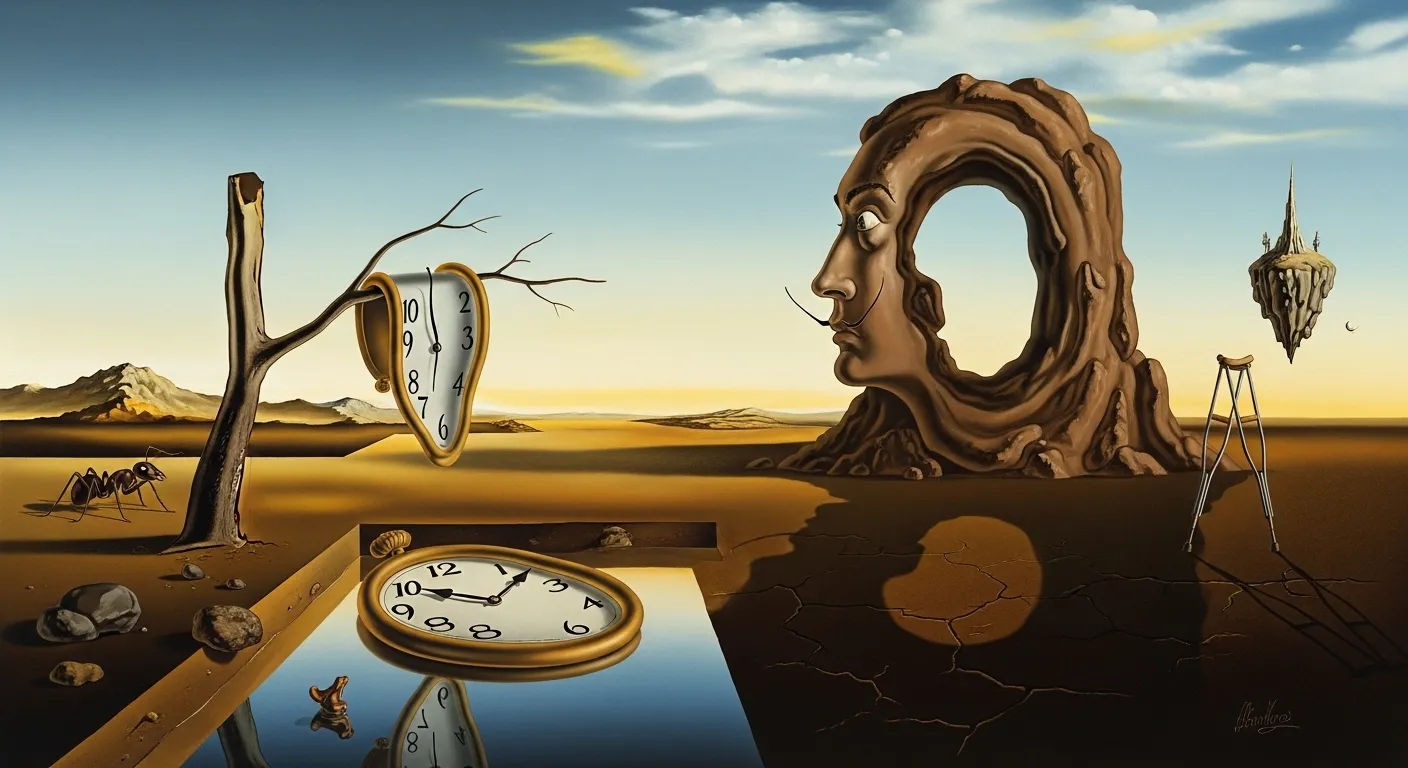
Let’s cut to the chase: when folks ask, “What is Salvador Dalí's most famous piece?” nine times outta ten, they’re thinkin’ of The Persistence of Memory. Painted in 1931, this tiny-but-mighty canvas (just 24 x 33 cm!) packs more existential dread than your average Netflix docu-series. Those droopy clocks? They ain’t just surreal—they’re a middle finger to Newtonian physics. Dali once said he got the idea from watching Camembert cheese melt in the sun. Seriously. Cheese. Not some grand philosophical epiphany—just gooey dairy under Spanish heat. Yet here we are, decades later, still arguing whether time is fluid or fixed, all thanks to salvador dali most famous works that whisper, “Hey bud, maybe reality’s just a suggestion.”
Dream Logic and the Surrealist Manifesto
Dali didn’t just paint dreams—he weaponized them. Deeply influenced by Freud’s theories on the unconscious, he developed his own method called “paranoiac-critical,” which basically meant staring at things until they turned into something else (a rock becomes a face, a cloud becomes a lobster telephone). This approach became the backbone of his salvador dali most famous works, where every brushstroke feels like a riddle wrapped in a hallucination. In Canada, we might say, “Eh, that painting’s got more layers than a Nanaimo bar”—and we wouldn’t be wrong. Dali’s dream logic wasn’t random; it was meticulously chaotic, designed to unsettle and seduce in equal measure. His canvases invite you in with velvet gloves… then lock the door behind you.
Lobster Telephones and Surrealist Objects
Who knew crustaceans and communication devices could spark such existential joy? Dali’s Lobster Telephone (1936) is one of those salvador dali most famous works that lives outside the frame—literally. Part sculpture, part joke, part Freudian nightmare, it blends eroticism, absurdity, and everyday objects into something utterly disarming. Imagine picking up the receiver and hearing a faint “click-clack” of tiny claws instead of your mom asking if you’ve eaten yet. That’s Dali: turning domestic mundanity into psychological theatre. These surrealist objects weren’t just art—they were conversation starters at parties where everyone wore berets and argued about Marx over cheap wine.
The Temptation of St. Anthony: Horses on Spider-Legs and Naked Angels
If you thought melting clocks were weird, wait till you meet the horses in The Temptation of St. Anthony (1946). Towering, skeletal creatures with impossibly long legs—like if a giraffe and a praying mantis had a baby during a fever dream—march across a barren landscape carrying golden nudes on their backs. This painting is peak salvador dali most famous works: theatrical, symbolic, and dripping with religious irony. Dali painted it for a film contest (he didn’t win), but it’s since become a cornerstone of his post-war period, where spirituality and sexuality tangoed in broad daylight. It’s less “saint resists temptation” and more “temptation throws a rave and invites the whole damn cosmos.”

Swans Reflecting Elephants: Double Images and Visual Trickery
Dali loved a good optical illusion almost as much as he loved posing dramatically in front of cameras. In Swans Reflecting Elephants (1937), he pulls off one of his signature double-image tricks: look at the swans on the lake, and their reflections morph into elephants with impossibly spindly legs. It’s visual poetry—quiet, elegant, and deeply unsettling. This piece is textbook salvador dali most famous works technique: using symmetry, reflection, and distortion to make your brain do backflips. You don’t just *see* the painting—you *solve* it. And even then, you’re never quite sure if you got the right answer. Kinda like trying to parallel park in downtown Toronto during rush hour—possible, but you’ll sweat through your shirt.
Gala: Muse, Manager, and Myth
Behind every great surrealist is a woman rolling her eyes while balancing his ego and bank account. Enter Gala—born Elena Ivanovna Diakonova, later Gala Dalí, eternal muse and de facto CEO of Team Dali. She appears in countless salvador dali most famous works, often floating, levitating, or lounging like a Renaissance Venus dipped in modern mystique. Dali once declared, “Gala is destined to be my Gradiva—the one who moves forward, my victory, my wife.” Without her, many argue, his career might’ve fizzled like flat pop. She negotiated contracts, curated exhibitions, and shielded him from critics who called his work “nonsense.” Spoiler: it *was* nonsense—but the kind that changed art history. So yeah, when you admire a Dali, tip your hat to Gala too.
From Catalonia to Hollywood: Dali’s Global Swagger
Dali didn’t stay put in Figueres, Spain, sipping sangria and sketching ants. Nah—he jetted off to New York, hobnobbed with Hitchcock, designed dream sequences for *Spellbound*, and even appeared on *What’s My Line?* wearing a diving helmet (true story—he nearly suffocated). His international fame amplified the reach of salvador dali most famous works, turning him into a brand before “personal branding” was a LinkedIn buzzword. Canadians might chuckle at his flamboyance—“Bit extra, eh?”—but you can’t deny his hustle. He sold perfume, illustrated books, and once gave a lecture in a Rolls-Royce filled with cauliflower. Because why not? If your art bends reality, your life might as well too.
Theatricality as Art Form
Let’s be real: Dali understood performance better than most actors. His waxed mustache, dramatic capes, and penchant for showing up late (or not at all) weren’t quirks—they were extensions of his salvador dali most famous works. He blurred the line between artist and artwork so thoroughly that sometimes it’s hard to tell which was the real masterpiece: the painting or the man posing beside it with a pet ocelot named Babou. In today’s terms, he’d have millions of TikTok followers filming himself “melting” ice cubes while whispering cryptic quotes. But back then? He just leaned into the absurdity and let the world catch up. And catch up it did—with museum wings, retrospectives, and enough merchandise to fill a mall.
Legacy, Influence, and Where to See His Works Today
So, what paintings did Salvador Dalí make that still matter? Loads. Beyond The Persistence of Memory, there’s The Hallucinogenic Toreador, Christ of Saint John of the Cross, Metamorphosis of Narcissus—each a universe unto itself. His influence seeps into everything from music videos (hello, Björk and Lady Gaga) to advertising campaigns that want to feel “edgy.” If you’re itching to see salvador dali most famous works in person, head to the Dalí Theatre-Museum in Figueres (his final resting place), or check out major collections at MoMA in New York or the Art Gallery of Ontario. And hey—if you’re browsing online, don’t forget to swing by SB Contemporary Art for deep dives, or explore our full View section. Craving more dream logic? Our piece on Salvador Dali Most Famous Artwork: Dreamlike Realms unpacks his weirdest visions with love and rigor.
Frequently Asked Questions
What is Salvador Dalí's most famous piece?
Salvador Dalí's most famous piece is widely considered to be The Persistence of Memory (1931), featuring those iconic melting clocks. This small but revolutionary canvas remains the definitive symbol of his contribution to surrealism and is central to discussions of salvador dali most famous works.
What is Dali's masterpiece?
While opinions vary, many art historians and fans regard The Persistence of Memory as Dali’s masterpiece due to its cultural impact, technical innovation, and enduring mystery. However, others champion works like Christ of Saint John of the Cross or The Hallucinogenic Toreador as deeper expressions of his vision. All are essential entries in the canon of salvador dali most famous works.
What is the #1 most famous painting in the world?
The title of "#1 most famous painting in the world" usually goes to Leonardo da Vinci’s Mona Lisa. However, within the realm of 20th-century art—and especially surrealism—The Persistence of Memory by Salvador Dalí stands as one of the most instantly recognizable images globally, making it a cornerstone among salvador dali most famous works.
What paintings did Salvador Dalí make?
Salvador Dalí created hundreds of paintings throughout his career. Key examples include The Persistence of Memory, Swans Reflecting Elephants, The Temptation of St. Anthony, Metamorphosis of Narcissus, Christ of Saint John of the Cross, and The Hallucinogenic Toreador. These form the core of salvador dali most famous works and showcase his evolution from dream logic to mystical realism.
References
- https://www.moma.org/artists/1281
- https://www.dalimuseum.org
- https://www.tate.org.uk/art/artists/salvador-dali-1073
- https://www.metmuseum.org/toah/hd/dali/hd_dali.htm